

Bar Stools for Luxury Projects: Hotel Bars, Clubs, Cafes and Showrooms
A bar stool is the smallest seat in a project and the first one a guest touches. It carries the first drink in a hotel lobby, the long conversation at a members club, the twenty minutes a buyer spends at the counter of a car showroom while the paperwork is printed. Get it right and the counter fills from the ends inwards. Get it wrong by three centimetres and the row stays empty, and nobody at the table will be able to say why.
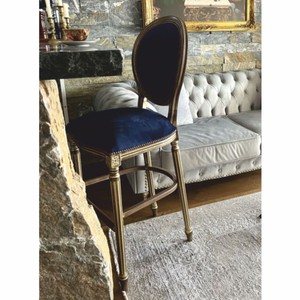
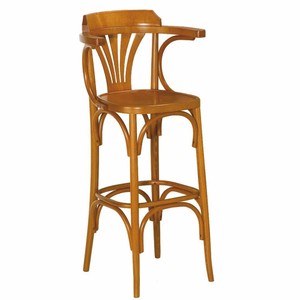
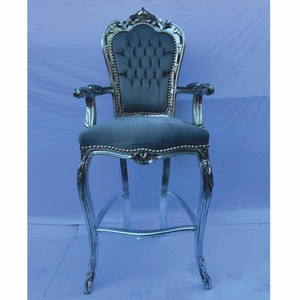
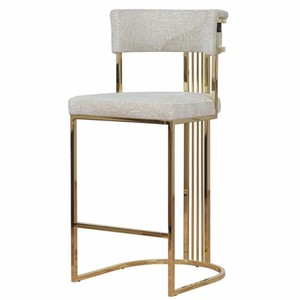
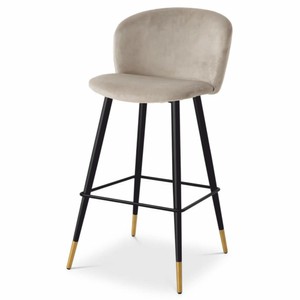
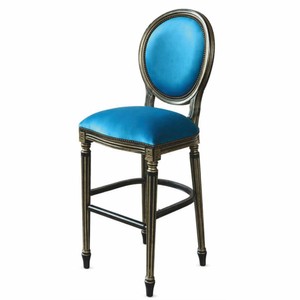
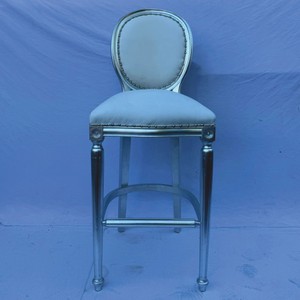
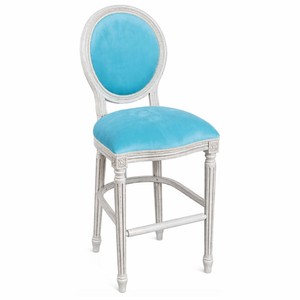
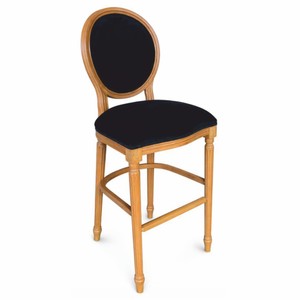
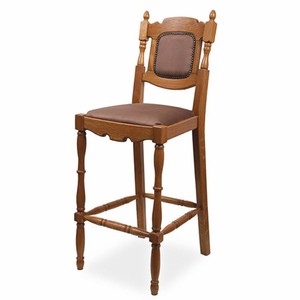
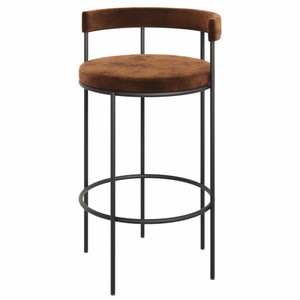
Casa Padrino is an internationally known name for luxury furniture, and tall seating is one of the areas where we are asked to think in projects rather than in single pieces. More than two hundred bar stools and bar chairs sit in our bar stool collection, in genuine leather, velvet, rattan, solid wood, polished brass and hand forged iron, in counter height and in bar height, with a separate range of luxury hotel bar stools built for rooms that are used every single day.
This page is written for the people who specify seating rather than buy one stool for the kitchen: hoteliers, club owners, restaurateurs, dealership managers, architects and interior designers. It walks through the rooms we are asked about most, then gives the measurements that decide whether a row of stools works, then the materials that survive a commercial counter. Everything on it is delivered worldwide, and bespoke work and project quantities are agreed individually.
Casa Padrino Projects: what a bar stool has to carry
A domestic stool holds one person for the length of a breakfast. A project stool is sat on and left again several hundred times a week, it is pushed sideways rather than lifted, it is cleaned with something stronger than water, and it has to look the same in year three as it did on the opening night. That is the difference between a piece of furniture and a piece of equipment, and it is decided in the frame, the fixings and the covering, not in the photograph.
Three things separate a project stool from a kitchen stool. The first is mass in the base: a heavy disc, machined flat and finished in brass or bronze, keeps a tall seat upright when somebody drops onto it from the side, which is how tall seats are always used and never how they are tested. The second is a footrest that is part of the structure rather than a decorative ring, because every guest puts their whole weight on it while climbing up. The third is a covering that can be renewed, since a seat that can be recovered on the existing frame turns a five year problem into an afternoon of work.
A project also has a rhythm a private buyer never sees. Rooms are done in phases, a second bar follows a year after the first, a damaged stool has to be replaced without the replacement standing out. We plan for that from the enquiry onwards, which is why we talk about series and quantities rather than about single articles.
Hotel bars, lobby bars and rooftop terraces
A hotel bar has to work at three different times of day. In the morning the counter is a place to read and take a coffee, at six it is the busiest twelve square metres in the building, and at midnight it is half empty and every stool is on show. Seating that only looks right when the bar is full has been photographed rather than planned.
For lobby and hotel bars we usually specify bar height stools with a low back and a swivel, upholstered in genuine leather in a colour taken from the counter rather than from the walls. The back decides how long a guest stays: a backless stool is elegant and honest, and it empties a bar after forty minutes, while a low bolster back, high enough to support the lower spine and low enough to slide under the overhang, adds an hour to the average stay without adding bulk. The swivel matters for another reason. At a hotel bar people arrive alone and turn towards each other, and a fixed seat forces the whole body to twist.
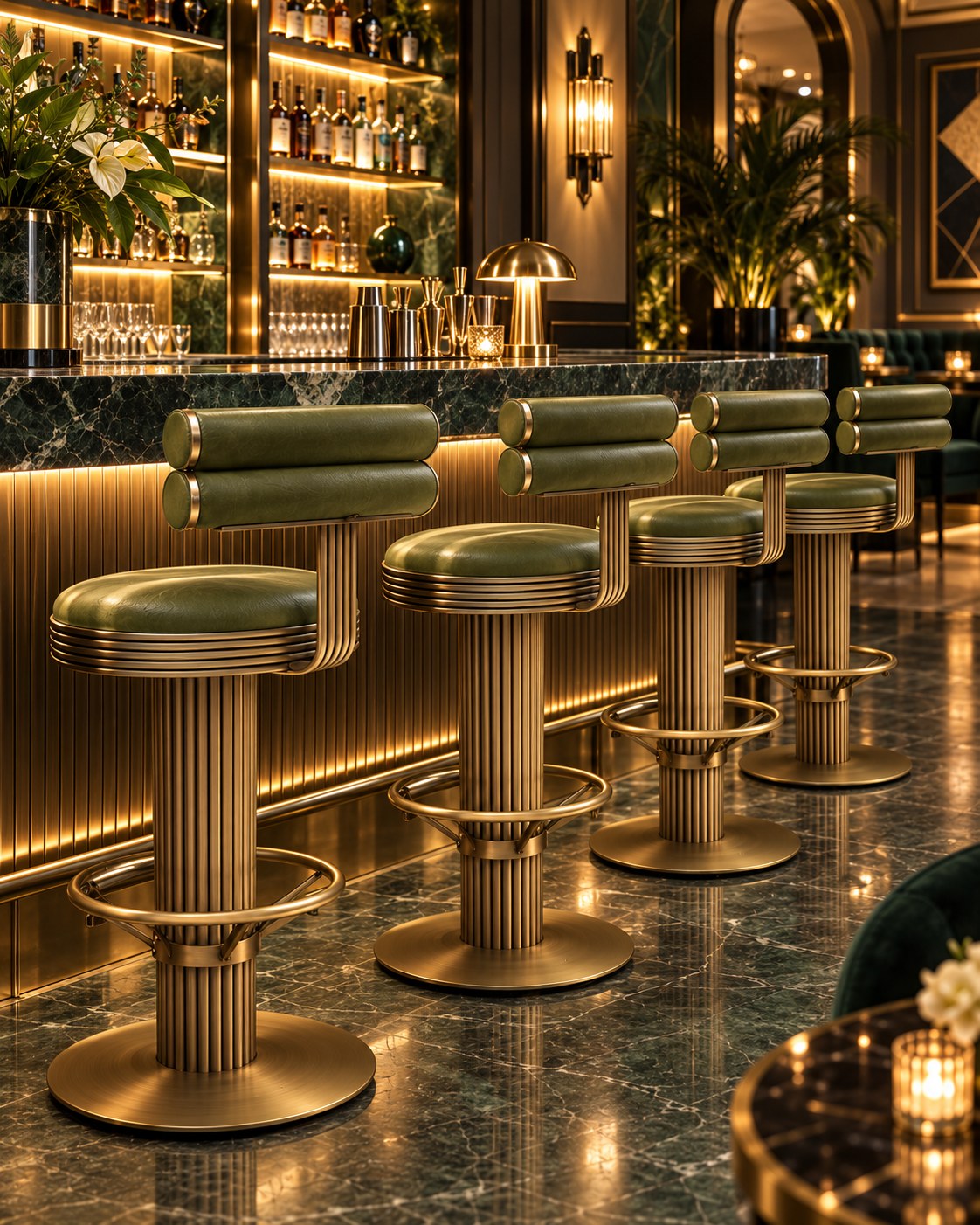
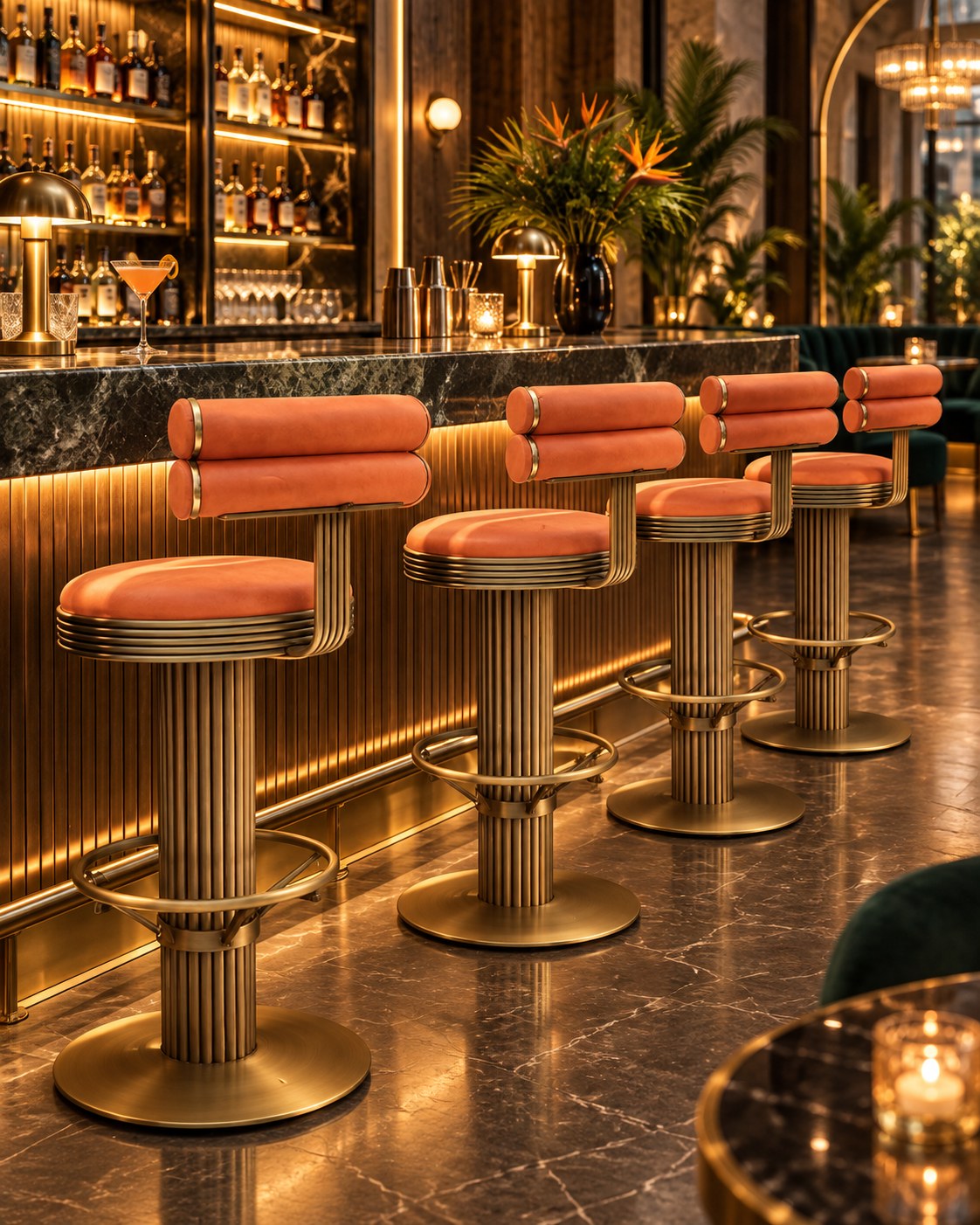
Colour is where a hotel bar earns its photographs. Deep green leather against green marble, black against dark stone, cream against walnut, warm coral against brass: the stool is the only object at the counter that can carry a strong colour without the room becoming loud, because it is small, repeated and low. Our wider hotel furniture and decoration range and our page on luxury hotel furniture follow the same logic through the rest of the house.
Private members clubs and night bars
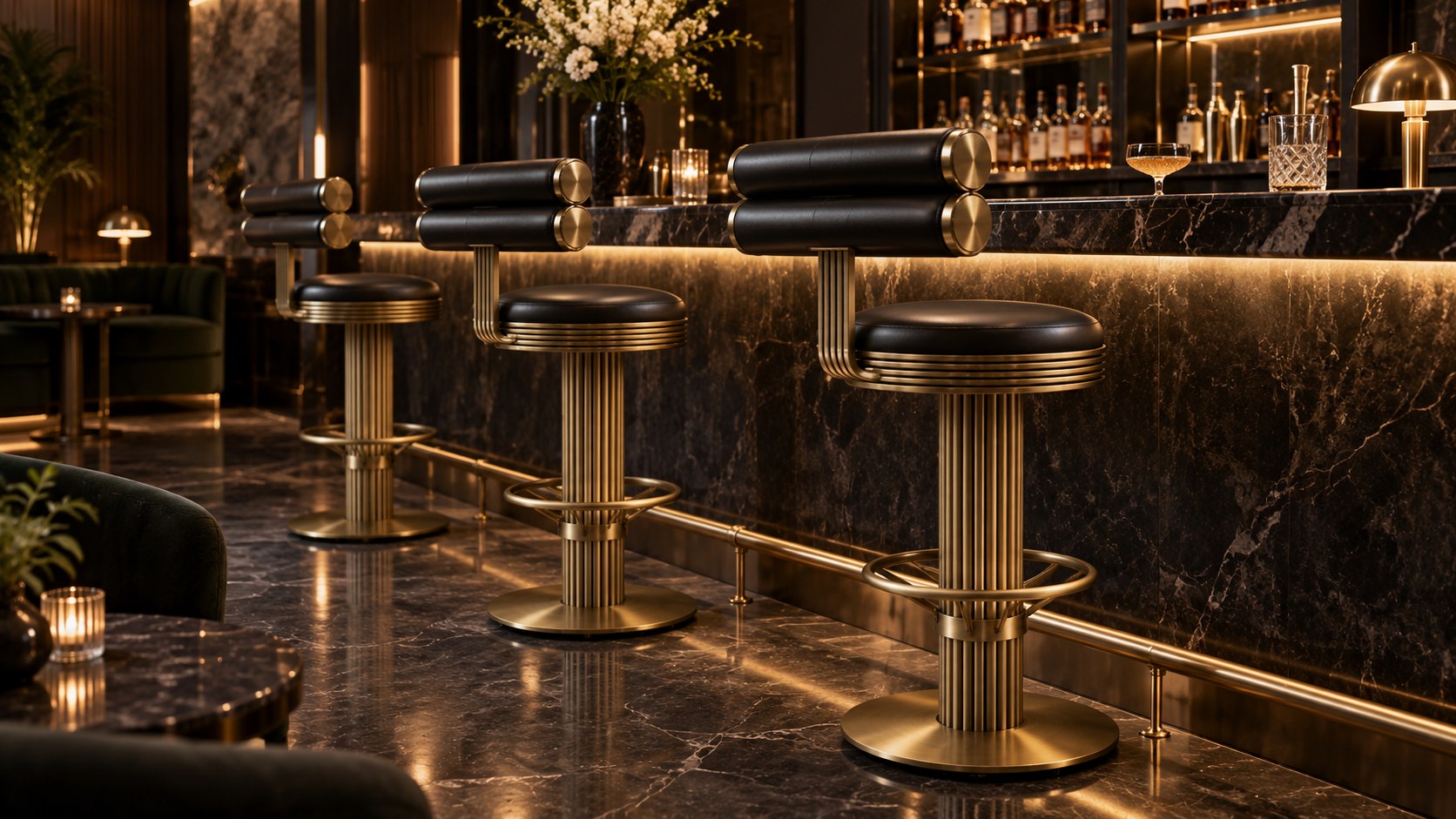
A club counter is the hardest test tall seating gets. The light is low, so the seat is read as a silhouette rather than as a colour and every reflection on the base counts double. The night is long, so comfort at the third hour matters more than comfort in the first minute. The room is loud, so guests sit closer together and turn more often than they would anywhere else.
Black leather over brass is the classic answer, and it is classic because it survives. Dark leather hides the marks a club counter collects, it takes candlelight and hidden strip lighting well, and it does not fight the bottles behind the bar, which are the only thing in the room that should be bright. Under it we want a wide disc base rather than four legs: four legs collect handbags, coats and feet in a dark room, and one clean circle can be swept around when the room is turned over at three in the morning.
For a club we also specify deeper padding over a firmer foam than for a hotel bar. A soft seat is a pleasure for twenty minutes and a complaint by midnight, because the sitter has slowly sunk two centimetres and the counter has quietly become too high. The same thinking runs through our Chesterfield furniture and our luxury armchairs, which often furnish the lounge seating around a club bar.
Cafes, patisseries and brasseries
A cafe counter turns over faster than any bar in this list, so the seating is built for arrival and departure rather than for the long sit. Guests come with coats, bags, laptops and pushchairs, they stay between eight and forty minutes, and they climb on and off the same seat several times an hour. Every one of those movements goes through the footrest and through the joint where the seat meets the column.
For a patisserie or a brasserie we usually recommend counter height rather than bar height. A counter at 90 to 95 cm with seats at 60 to 65 cm lets a guest step on and off without a climb, keeps children and older guests comfortable, and makes the room read as open rather than as a bar. Where the counter has to be tall, a generous footrest ring and a base that will not tip under a one sided load are the two details worth paying for.
Velvet and boucle look beautiful in daylight and are a poor idea within two metres of an espresso machine or a pastry case. Leather, coated fabric and cane wipe clean and take the daily traffic without a mark. Where a room needs softness we put it into the banquettes and the loose seating, using our luxury chairs and dining tables, and keep the counter itself in materials that clean in one pass.
Showrooms, car dealerships and brand lounges
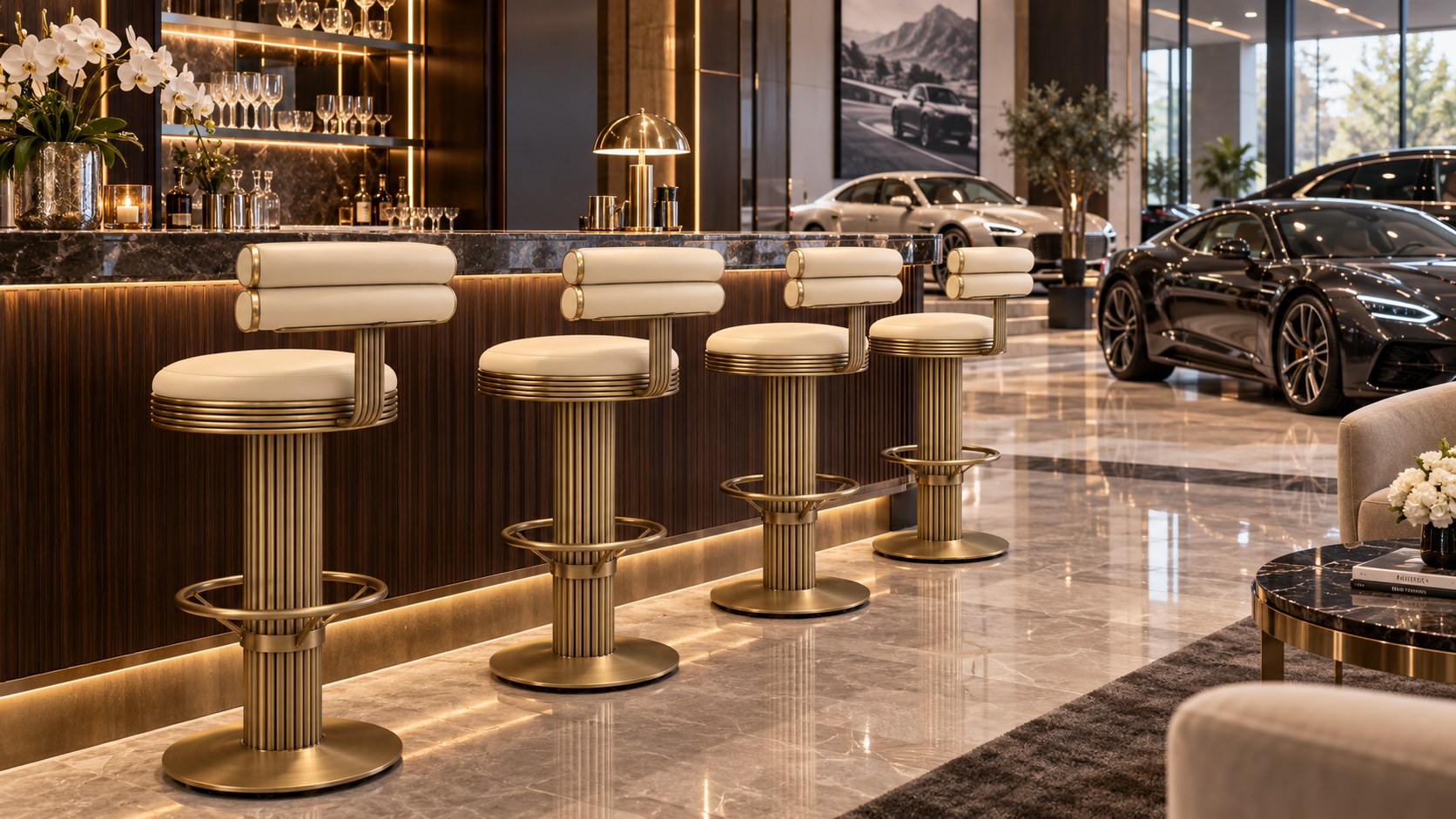
The showroom counter is the least discussed and one of the most rewarding places to put good seating. A car dealership, a watch salon, a yacht broker and a private bank share the same problem: a customer has to spend twenty to ninety minutes in a very large, very hard, very bright room while a decision is made, and the furniture is the only thing that tells them how the house sees them. A row of brass stools at a stone counter, with coffee and a view onto the floor, does more for the tone of that conversation than any brochure.
The requirements are specific. Showroom floors are polished stone or resin, so felt or leather glides are essential and a disc base is safer than four points, because it spreads the load and cannot leave four small marks. The lighting is bright and even, which is unkind to thin metal and generous to solid brushed surfaces. And the seat has to look correct when empty, because for most of the day it is empty and it is standing in the middle of the display.
Cream and sand leather works particularly well against dark panelling and against cars, because it lifts the counter without competing with the paintwork on the floor. Brand lounges in fashion, jewellery and hospitality use the same recipe. Where the lounge needs seating away from the counter, our luxury sofas and mirrors carry the material language through the room.
Restaurants, chef counters and private dining
The chef counter has changed restaurant seating more than any other idea of the last twenty years. A guest who eats at the pass sits for two hours at a height designed for standing work, in a warm zone, in full view of the kitchen. That seat has to be genuinely comfortable, quiet when it moves and wipeable at the end of service.
We specify a back on every chef counter seat without exception, a footrest set for a two hour sit rather than a quick perch, and leather rather than fabric because of the heat and the steam. Spacing is generous, 70 cm from centre to centre or more, because the guest is served from the front and needs elbow room on both sides. For the rest of the room our page on luxury restaurant furniture covers tables and chairs, and our chandeliers and lamps finish the counter above.
Yachts, spas, terraces and private residences
Salt air, chlorine, sun and rain each attack a different part of a stool. On a yacht or a terrace the enemy is corrosion, and the answer is either powder coated metal that is inspected and touched up every season or hand forged iron that is expected to develop a patina and is maintained on purpose. Bare polished brass outdoors will go dark within one season on the coast, which some clients want and others discover with surprise, so it is worth deciding in advance. Our garden furniture and outdoor decoration range is built around exactly that conversation.
Spa and pool bars add humidity and sun cream, which between them destroy untreated wood and light fabrics; leather with a protective finish, cane and metal are what survive. In private residences the brief is the opposite. The home bar and the kitchen island are used gently but looked at constantly, so this is the place for the most expressive materials, the boldest colour and the finest finishes, as on our page for luxury villa furniture.
- Hotel bars, lobby bars, rooftop bars and club floors
- Private members clubs, cigar lounges and night bars
- Cafes, patisseries, brasseries and bakery counters
- Restaurants, chef counters and private dining rooms
- Car dealerships, watch salons, yacht brokers and brand lounges
- Spa bars, pool bars, terraces and beach clubs
- Private villas, home bars, kitchen islands and cellar tasting rooms
- Offices, boardroom kitchens and staff lounges in representative buildings
The two standard heights, and the arithmetic behind them
Everything above depends on one subtraction, and it is the most common reason a delivered stool goes back. Take the height of the counter and subtract 25 to 30 cm. That is the seat height you need. Twenty five centimetres is tight and correct for a slim counter, thirty is comfortable, and anything under twenty five leaves no room for the thighs.
That gives the two families the market is built on. A worktop or kitchen island at 90 to 95 cm asks for a counter height stool with a seat at 60 to 65 cm. A bar counter at 105 to 112 cm asks for a bar height stool with a seat at 75 to 80 cm. As a control, an ordinary dining table at 75 cm takes a chair with a seat at 45 cm, which is the same subtraction and the reason the rule can be trusted.
| Counter | Height | Seat height | Typical room |
|---|---|---|---|
| Dining table | 75 cm | 45 cm | Restaurant, private dining |
| Kitchen island, cafe counter | 90 to 95 cm | 60 to 65 cm | Cafe, patisserie, villa kitchen |
| Bar counter | 105 to 112 cm | 75 to 80 cm | Hotel bar, club, showroom |
| Poseur table | 100 to 110 cm | 75 to 80 cm | Event floor, terrace |
Two refinements decide the difficult cases. Measure to the underside of the counter, not to the surface. A five centimetre stone top on an eight centimetre rail sits thirteen centimetres lower than the finished height suggests: a bar at 110 cm has an underside at 97 cm, and an eighty centimetre stool then leaves seventeen centimetres for the knees, where the correct seat is 70 to 72 cm. And allow for the overhang. Twenty five centimetres of counter projection is the minimum for knees, thirty is comfortable, thirty eight lets a guest sit square to the counter rather than side on.
The last trap causes more returns than any other, so it is worth stating plainly. Overall height is not seat height. Product names in this category almost always quote the total height of the piece, so a stool described at 96 cm or 112 cm has a seat roughly 25 to 30 cm below that figure once it has a back. If a specification lists one number only, ask which one it is before the order is placed.
Spacing, walkway, footrest and swivel
Spacing is measured from centre to centre, never from edge to edge, and it runs from 55 to 75 cm depending on the stool: 55 to 60 for a backless seat, 60 to 68 with a back, 70 to 75 with arms or a swivel, because a turning guest needs the width of their own shoulders on both sides. In a commercial room, plan the generous end of that range. A counter with four comfortable seats earns more than a counter with six uncomfortable ones.
Two worked examples make it concrete. A two hundred centimetre island takes three stools, at forty, one hundred and one hundred and sixty centimetres, with fifteen centimetres of air at each end; a fourth would force the spacing down to fifty and the row would be used by two people. A two hundred and forty centimetre counter takes four at sixty centimetre spacing and reads as generous. Behind the row, allow forty five centimetres for the stool, another forty five for a guest standing up and then the walkway itself, so about one hundred and eighty centimetres to the wall behind, with ninety centimetres of clear passage as the absolute minimum where staff have to pass.
Stools can only be pushed under a counter if the top of the back sits below the underside of the top, which is why a low bolster back is worth more in a project than a tall one. The footrest sits forty to forty five centimetres below the seat, so twenty to twenty five centimetres above the floor on a counter stool and thirty five to forty on a bar stool. On a swivel, look for a mechanism that returns or holds rather than spinning freely: a free swivel never lines up with the counter, and a row of them never looks tidy.
Leather, velvet, rattan, brass and forged iron
Genuine leather is what we recommend most often for a project, for a simple reason: it is the only common covering that improves with use. It takes the heat of a chef counter, the humidity of a pool bar and the traffic of a hotel lobby, it wipes clean, and after two years it looks intentional rather than tired. Dark colours hide the life of a busy counter; cream and sand look extraordinary in a showroom and need a house willing to clean them.
Velvet belongs where the counter is a stage rather than a workbench: cocktail bars, club floors, private dining. It carries colour better than any other covering and it is the fastest way to give a brass and marble room warmth. It also marks, so we keep it away from espresso machines and open kitchens. Rattan and cane bring weight down and let air through, which suits terraces, resorts and coastal residences, though they dislike direct rain and dry heat in equal measure.
Solid wood frames give the quietest, most traditional look and take the heaviest use when the joints are dowelled and glued rather than screwed. Brass and bronze, brushed rather than mirror polished, photograph best under warm light and hide fingerprints: a lacquered finish keeps the colour, an unlacquered one will patinate and can be brought back with a polish. Hand forged iron is the outdoor material, expected to weather, and it wants an inspection and a touch up once a season on the coast.
Specifying a project: quantities, reordering and replaceable covers
A project enquiry is quicker to answer than most people expect, and five figures do almost all of the work: the finished height of the counter, the height to its underside, the clear length of the counter, the number of seats wanted and the date the room opens. With those we can say what will fit, how many seats the counter really takes and what is available in the time you have.
Three further questions decide the long term result. Do you want a back, and should the stools push under the counter when the room is cleaned. Is the floor stone, timber or carpet, which sets the glides. And will there be a second phase, because if a terrace or a second bar follows next year it is worth choosing a series with depth rather than the last twelve pieces of something. Bespoke work, project quantities and individual coverings are agreed case by case, and we work regularly with architects and interior design studios who specify for their own clients.
Counter height, height to the underside, clear counter length, number of seats, opening date. Add the floor covering and a photograph of the counter if you have one, and we will come back with what fits and what is available. Enquiries go through our contact page, by telephone or by email, and we advise on projects from the first sketch to the delivery.
Delivery, floor protection and care
We deliver worldwide. Standard delivery is kerbside, which means the goods are brought to the property boundary and handed over there; carrying into the building, up stairs or into the room itself is not part of a standard delivery, so on a project it is worth having staff or a fitter on site on the day. For larger orders we agree the delivery window in advance, so that a bar or a lobby is not blocked during service.
Before the stools are placed, fit the glides: felt on timber and stone, hard plastic or rubber on carpet, checked twice a year, because a lost glide will score a polished floor within a week. Leather wants a dry cloth, an occasional wipe with a barely damp one and a conditioner once or twice a year, and it should be kept out of direct sun, which fades and dries it faster than any amount of use. Velvet is brushed rather than rubbed, and metal bases take a dry cloth, never a solvent or an abrasive. Once a season, put a spanner on the fixings under every seat in a commercial room: tall seating loosens from the sideways movement of people climbing on and off, and a stool that starts to rock will fail at the joint if it is left alone.
Why Casa Padrino
Casa Padrino furnishes hotels, restaurants, clubs, villas, castles, showrooms and yachts across Europe and far beyond it. Our range is deliberately wide, because a project is rarely one category: the client who needs twelve bar stools needs the lounge seating around them, the lighting above them and the mirrors behind them, and drawing all of it from one house keeps the material language consistent and the delivery to one date.
We work with architects, interior designers, project developers and owners directly, we quote project quantities, we advise on measurement before an order rather than after it, and we say plainly when a piece is not right for a room. What we offer is exclusive material, real craft and pieces that hold their appearance under daily use, delivered internationally.
Frequently asked questions about bar stools
What seat height do I need for a 110 cm bar counter?
Between 75 and 80 cm in the normal case, following the rule of subtracting 25 to 30 cm from the counter height. Check the underside before you order: if the top is thick or sits on a rail, the underside may be at 97 cm, and then the correct seat height is 70 to 72 cm. The measurement that matters runs from the floor to the underside of the counter, not to its surface.
What is the difference between a counter stool and a bar stool?
Only the height, but that height changes everything. A counter stool has a seat at 60 to 65 cm and belongs at a kitchen island or a cafe counter of 90 to 95 cm. A bar stool has a seat at 75 to 80 cm and belongs at a bar counter of 105 to 112 cm. A bar stool at an island leaves the guest sitting above the worktop, and a counter stool at a bar puts the counter at chin height.
Is the height given in a product name the seat height?
Usually not. In this category the quoted height is almost always the overall height of the piece, measured to the top of the back, and the seat then sits roughly 25 to 30 cm below that figure. A stool listed at 96 cm overall has a seat somewhere near 66 to 70 cm. If a specification gives one number only, ask which measurement it is before ordering, because this single point causes more returns than any other.
How many stools fit along my counter?
Allow 55 to 75 cm from centre to centre, depending on the stool: 55 to 60 without a back, 60 to 68 with a back, 70 to 75 with arms or a swivel. Leave about 15 cm of air at each end. A two hundred centimetre counter takes three seats comfortably and a two hundred and forty centimetre counter takes four. In a commercial room, choose the generous spacing rather than the extra seat.
Do I need a footrest?
Above a seat height of 60 cm, yes. Without one the legs hang, the sitter braces against the counter and the seat becomes uncomfortable within minutes. The footrest should sit 40 to 45 cm below the seat, and in a commercial room it should be part of the structure rather than a decorative ring, because every guest puts their full weight on it while climbing up.
Which covering lasts best in a hotel or a club?
Genuine leather, in a dark colour where the counter is busy. It takes heat, humidity and daily traffic, it wipes clean and it ages into something that looks intentional. Velvet is the right choice where the counter is a stage rather than a workbench, and coated fabrics and cane suit cafes and terraces. Where a covering will take heavy use, a seat that can be recovered on the existing frame is worth more than a slightly better original fabric.
Are your bar stools suitable for commercial use?
Our hotel and project range is built for it: heavy disc or wide bases, structural footrests, dowelled or welded frames and coverings that can be renewed. For a specific project tell us the room, the expected use per day and the counter dimensions, and we will say which series is the right one. Where a piece is intended for domestic use rather than a busy bar, we say so.
Can I order stools in a specific colour or in larger quantities?
Bespoke work, project quantities and individual coverings are agreed case by case. Send us the room, the number of seats and the date, and we will come back with what is possible in the time available. On a phased project it is worth choosing a series with depth from the start, so that a second bar or a terrace can follow later without a visible difference.
Can bar stools be used outdoors on a terrace or at a pool bar?
Hand forged iron and powder coated metal are the materials that survive outdoors, with an inspection and a touch up once a season and more often near the sea. Salt air is the hardest condition of all: unlacquered brass will darken within a season on the coast, which is a patina if it is planned and a surprise if it is not. Upholstery, untreated wood and light fabrics belong under cover.
How are the stools delivered?
Worldwide, kerbside as standard. The goods are brought to the property boundary and handed over there, so carrying into the building or up stairs is not part of a standard delivery and it is worth arranging staff or a fitter for the delivery day. For larger orders we agree the window in advance so that the room stays usable.
Casa Padrino is an international supplier of luxury furniture for private residences, hotels, restaurants, clubs, showrooms and complete project fit outs, with exclusive materials, genuine craft, bespoke work and worldwide delivery. Our full collection, from tall seating to complete interiors, is at https://www.casa-padrino.de/en.